Vegas PBS Interim President & General Manager John Turner shares his perspectives on the resilience of communities.
I’ve had the opportunity to see communities from many different perspectives. I’ve lived and worked in them, served them as an auxiliary police officer, reported on them as a journalist and, at times, watched them go through circumstances that tested just how strong they really were. But for all of that, I’m not sure I ever really stopped to think about what community actually means.
Maybe that’s the thing about community. Most of the time, we don’t really notice it until something happens that reminds us just how much we depend on one another.
My career in television news took me from Los Angeles and the Pacific Northwest to Las Vegas, and eventually much farther from home. I’ve seen communities that were very different from one another, each with its own identity and its own way of coming together.
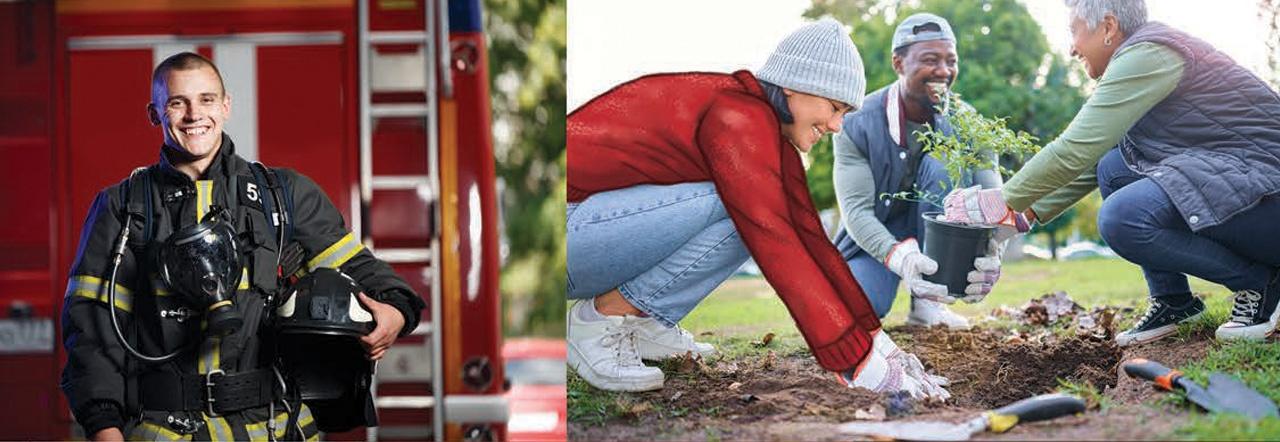
I also spent years as an auxiliary police officer, where community-based policing gave me another way of looking at all of this. You learn pretty quickly that you can’t effectively serve a community without knowing something about the people who live there. Police officers and firefighters have a role in keeping a community safe, but they can’t do it alone. There has to be trust. People have to look out for one another.
Over the years, I’ve seen communities tested in ways no one would ever choose. Earthquakes, hurricanes and floods can change a neighborhood in minutes. Tornadoes can tear through a small town. Civil unrest can create fear and uncertainty. War can take a family member thousands of miles from home. And during COVID, we all experienced what it was like when simply being together suddenly became difficult.
The circumstances are different, but the response is often familiar. People step in. A neighbor checks on an older couple down the street. Someone brings a meal to a family whose loved one has been deployed. After a storm, people who may barely know one another start clearing debris together. During COVID, we found new ways to check on family, friends and neighbors when we couldn’t always be there in person.
None of that makes the hardship disappear. But I think it tells us something about community. When life disrupts the things we normally take for granted, we become much more aware of how much we depend on one another.
Maybe that’s when we see community most clearly.
For me, perhaps the most powerful example happened right here at home.
On October 1, 2017, Las Vegas experienced something none of us could have imagined. What happened in the hours and days afterward said a great deal about this community.
People stood in line for hours to donate blood. Restaurants and businesses provided food and supplies. People brought water to strangers waiting in line. First responders and medical professionals did extraordinary work, but so did ordinary people who simply saw something that needed to be done and did it.
For a city the rest of the world often sees as resorts, casinos and entertainment, October 1 reminded us of something we already knew. Las Vegas wasn’t simply a destination. It was home.
Just days later, the Vegas Golden Knights began their first season. Nobody could have planned what that team would come to mean to Las Vegas at that particular time. Hockey certainly didn’t heal what happened on October 1. Nothing could. But the Golden Knights gave people another place to gather. They honored victims and first responders and gave this community something to rally around when I think we needed it.
That first season became about much more than hockey.
My years in broadcasting have also taught me that media has a responsibility to the communities we serve. A local television station shouldn’t simply talk to a community. It should listen to it. At its best, public media introduces us to people we might otherwise never meet and tells stories that help us better understand the place we call home.
But there’s another lesson in all of this. We shouldn’t need a hurricane, a pandemic or a terrible night in our own city to remember that we are neighbors.
Be My Neighbor Day, which Vegas PBS celebrates each year and will again this October, feels important to me. It gives children, families and neighbors an opportunity to come together when nothing is wrong. No emergency. No tragedy. Just people spending time together, getting to know one another and perhaps being reminded that community isn’t something that simply surrounds us. It’s something we participate in.
Fred Rogers spent much of his life helping children understand what it means to be a neighbor. It sounds like such a simple idea, but I think there’s a lot behind it. A neighbor isn’t just somebody who happens to live next door. Being a neighbor means noticing other people. It means participating. Sometimes it means helping. And sometimes it simply means being there.
I’ve seen what happens when communities are tested. What I’ve come to believe is that the strongest communities don’t wait until something goes wrong to care about one another.
Mr. Rogers asked generations of children, “Won’t you be my neighbor?”
This October, Be My Neighbor Day gives all of us another opportunity to answer yes.