This November, Vegas PBS premieres Ken Burns and Lynn Novick's Crime and Punishment in America, which mentions the Kefauver Committee, the Senate investigation that held a hearing in Las Vegas in 1950. That's why we're approaching the series through a local lens.
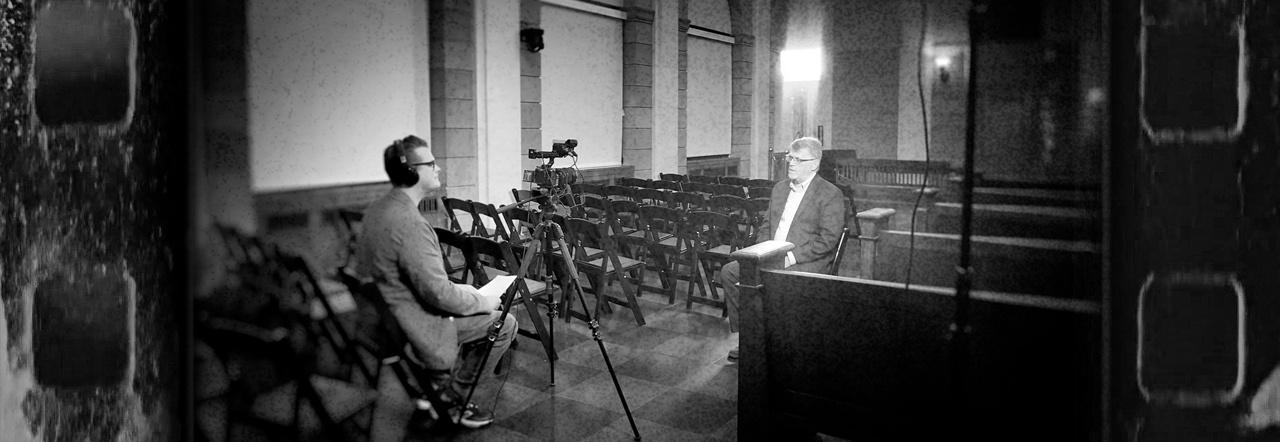
Geoff Schumacher, Vice President of Research, Collections and Programs at The Mob Museum, spoke with us for a portion of the interview in the museum's second-floor courtroom, the original federal courtroom where that hearing took place. This is an edited excerpt.
How has crime shaped Las Vegas?
A big part of the economy here was developed by criminals. Organized crime figures came to Las Vegas starting in the 1940s and invested in the casino industry. They were also skimming, taking money off the top and sending it back east. So, there's a good and a bad to it. Ultimately, we collectively determined it was time for the mob to move on. State gaming regulators, local police, and federal agencies banded together to push organized crime out and open the door for corporate investment, which is what we see today.
What was Las Vegas like during Prohibition?
A small railroad town, a few thousand people looking for a new reason to exist. Nevada wasn't enforcing Prohibition, so federal agents had to come from San Francisco or Los Angeles, and they could only afford to do that once in a while. Then Hoover Dam construction began in 1931, the same year Nevada legalized gambling. While the country was banning alcohol, Nevada went the other direction.
How did the Great Depression change American law enforcement?
The country was struggling, and one reaction was bank robberies. The banks were the bad guys, but they had the money. You had the rise of John Dillinger and Baby Face Nelson, famous or infamous for brazen robberies and kidnappings. The federal government decided to respond in a big way, and the FBI under J. Edgar Hoover was transformed into the crime-fighting force we know today. Before that, the FBI was mostly accountants and lawyers going after white-collar crime. Agents learned how to shoot guns, started carrying them, and tracked down almost everybody involved, either killing them or putting them in prison. It really made the reputation of the FBI.
Was the FBI active in Las Vegas then?
Not yet. Las Vegas was still a very small town, and Reno was a bigger deal. It didn't attract the attention of the FBI or any other outside entities. That changed in the 1940s with World War II, the Army Air Base, which is now Nellis Air Force Base, and the Basic Magnesium plant. Those projects brought tens of thousands of people here. We transformed from a town into a city, and when that happened, the FBI took notice.
What was the Kefauver Committee's effect on Las Vegas?
It didn't shut down gambling in Nevada. It shut down illegal gambling around the country. That gave Las Vegas effectively a monopoly, and the experts from places like Newport, Kentucky, and Saratoga Springs, New York, all migrated here. Kefauver surely thought he might shut down gambling in Nevada, but we saw it as an opportunity more than a hindrance.
What was the most shocking detail from the Las Vegas hearing?
Wilbur Clark was the frontman for the Desert Inn, but the real owners were the Cleveland Syndicate. Asked about his partners, he played dumb, and it wasn't very convincing. Then there was Cliff Jones, part owner of three casinos while serving as lieutenant governor. That may not seem odd to us, but people outside Nevada saw it as reflective of the loose nature of the state.
What is Bugsy Siegel's lasting impact?
He was only here for a short time, but his impact is still felt. He understood that people came for the resort experience, not just to gamble. You see that in every resort on the Strip. There's also the dark allure. He was murdered six months after opening the Flamingo, and that created an aura around Las Vegas, this somewhat dangerous, underworld aspect that visitors still sense.